
 After three straight adrenaline-fueled episodes, Battlestar Galactica returned from its Memorial Day hiatus with “Sine Qua Non”, a frustratingly uneven character study probing into the collective consciousness of those left behind in the wake of the events in “Guess What’s Coming to Dinner?” It’s tempting to think of “Sine Qua Non” as a regression of sorts, a callback to the meandering character sketches of the first few episodes of BSG’s fourth and final season. But whereas those earlier revelations often felt frivolous, exploring the remaining fleet’s reaction to the disappearance of their President, to say nothing of half the fleet’s military strength, was of the utmost importance.
“Sine Qua Non” opens up promisingly enough, with a blizzard of washed-out hallucinatory sequences imagined by Natalie, the gutshot cylon leader, superimposed against a flurry of medical activity, as Galactica’s medics rush to resuscitate their new ally. They fail through no fault of their own, and with her last act Natalie, true to the sensuous nature of her model, grasps blindly for one last physical touch, here provided by the good Doc Cottle. Apparently I was wrong in my speculation that she might be the dying leader. Ah well.
Elsewhere, Vice President Tom Zarek, the former terrorist and master politician, attempts to assume control of the Presidency, as stipulated in the constitution. In a strange turn, the normally expedient Admiral Adama—the man who accepted the presidency of Gaius Baltar, for goodness’ sake—outright refuses to acknowledge Zarek’s legitimacy, and so the youngest member of the quorum, the Admiral’s son Lee, is tasked to find a suitable replacement for Zarek, while the Admiral is forced to look within for the first time in a great while. Thus are the two main thrusts of this episode launched. It was always apparent to anyone paying attention that Lee’s foray into politics was going to result in him becoming President. And that’s okay—inevitability is a perfectly acceptable narrative choice, provided the journey in question is handled deftly. Unfortunately it hasn’t been. Lee has always been the least defined character on the show, and his dealings with the quorum this season have totally compounded this. Jamie Bamber is a great actor, but his recent scenes, apart from negotiating the safety of Gaius Baltar, have always seemed perfunctory at best, superfluous at worst. That dynamic continues here, as the writers had to bring in Romo Lampkin, erstwhile public defender, just to get Lee sped along.
Lampkin is a bit like Anton Chigur—he’s a force of nature, more a collection of tics than anything recognizably human. I always liked him, but he was totally unnecessary in “Sine Qua Non”. The entire point to his presence was to reiterate and reilluminate the survivor’s guilt, which of course brings up a problem. The logistics of Galactica ensure that we’re never far away from any of the survivor’s guilt, so focusing on Romo’s anguish didn’t add anything to this equation. Indeed, it was mostly mimicry, as Romo Sixth-Sensing his wife’s cat echoed the guilt of both Saul Tigh, who sees his dead wife in the face of his current lover, and Admiral Adama, who has conversations with his dead ex-wife each anniversary. Lampkin is a secondary character in the midst of the show’s final season, and having him complete a totally unbelievable arc (in the span of a single episode, no less) was a colossal waste of time.
As Galactica moves more and more towards character-specific episodes, it often leaves us some crucial character in the lurch. Take Saul Tigh, who has been largely relegated to the periphery for much of this season. Because we haven’t seen much of him, two starting developments—Saul impregnating Caprica-Six (what’s Baltar gonna think?), and Saul assuming command of the Galactica, didn’t strike home with nearly as much force as intended. But hey, at least we got to see Romo get a new dog.
Lampkin also pops up in Bill Adama’s narrative, as he once again tells someone something they should already know, namely, Bill hearts Laura: “Sine qua non … those things we deem essential, without which we cannot bear living. Without which life in general loses its specific value, becomes abstract.” From Galactica’s outset, there has been romantic tension between Adama and Roslin. But they’ve always danced around it, which, come to think of it, is probably a good thing. When BSG’s other two leads, Starbuck and Apollo, finally decided to explore their oft-ignored personal feelings, it erupted in an angsty, completely forgettable mess that was painful for both viewer and character to watch. But Adama’s intentions here are much more pure. Starbuck and Apollo hooked up because they could; Adama, thanks to Roslin’s abduction, has his hand forced. He might not ever unite with his love—this is Battlestar Galactica, after all—but as the camera pulls back on his lone raptor framed against the oblivion of space, it's clear that he’s damned sure going to try.
Tuesday, June 3, 2008
Battlestar Galactica: Season 4, Episode 8, "Sine Qua Non"

Monday, May 19, 2008
Battlestar Galactica: Season 4, Episode 7, "Guess What's Coming To Dinner?"
There were great looks from the final four as they realized what these revelations of earth and mortality mean to them: Saul Tigh (Michael Hogan) just wants to be done with the whole thing, desperate to keep his humanity intact (his first instinct aboard the basestar wasn’t to tinker with its controls, but to determine the party responsible for shooting Gaeta), while Tory Foster (Rekha Sharma), who has been embracing this whole cylon thing with an appalling amount of zeal, looks horrified that her shot at immortality is being taken away from her. That revelation brought Tory back to her most recognizably human form since last season; she was genuinely hurt by Roslin impugning her character, and pumping Gaius for information (literally! Zing!) marked the first time this season she was acting in someone else’s interests, not her own. Meanwhile, Anders (Michael Trucco) just can’t stop feeling guilty. How much of that stems from shooting Gaeta the man, and how much of that stems from shooting Gaeta the potential cylon—who in now the 5th person to ever sing in the show, the first four all being cylon—is certainly up to debate, but the pain on Trucco’s face was palpable. People are already parsing through the song’s lyrics for potential meaning (you can read about the composition process at composer Bear McCreary’s wonderfully detailed blog), but it worked on a different level for me, providing an elegiac counterpoint to Lee Adama (Jamie Bamber) playing the hero and imploring Roslin to explain her actions. She acquiesces, which is consistent with the changes of last week, but she’s still ultimately disdainful of representative democracy. When that capitulation results in Natalie (Tricia Helfer again) explaining her actions to the quorum, a very grave Starbuck, watching the proceedings with a keen eye, realizes that the hybrid’s warning—that she, Kara, the harbinger of death—takes on a new significance. Thrace begins to realize that, hey, maybe it’s a positive appellation, referring not the destruction of mankind but to the potential loss of immortality among the cylons. That realization led to a reunion of sorts for Thrace and Roslin, who had bonded over religious imagery so many times before, promising to help each other ascertain the facts of the opera house, an ominous development underscored once more by Gaeta’s elegiac soprano. That scene, in addition to showing Kara finally getting her shit back, set most of the rest of the events in motion. Half the principal cast is now trapped aboard the commandeered basestar with its twitchy, sentient centurions (even if the skinjobs have been robbed of their menace, the centurions sure haven’t) being spirited away against their will; Laura bringing Searider Falcon aboard the ship, suggesting she and Adama will never get to consummate their relationship. And, of course, Sharon Agathon shooting Natalie two times in the chest (what’s with the number eights never getting any headshots?) to protect her child, calling into question whether or not Roslin is still the prophesied dying leader—might Natalie now be? Some people have had problems with that last one, since Natalie is very clearly not Caprica-Six, the model in the shared visions, and Sharon above all should know that not all cylons are created equally. But at the same time I really can’t find fault, since the disorienting nature of Hera’s actions were very creepy to watch, and would set any parent on edge.  If the first few episodes of Battlestar Galactica’s fourth and final season—obsessed as they were with exploring the collective psyche of the principal cast—managed to repulse many viewers expecting a more dynamic payoff to the revelations from the show's 3rd season, “Guess What’s Coming to Dinner?” should satisfy that greedy, plot-crazed mob. Penned by longtime Galactica scribe Michael Angeli (who can have some trouble with prolix dialog, but is absolutely redoubtable with the show’s hallmark actiony sequences), the episode was a mirror of seasons past: a desperate flight from a cylon threat, Starbuck (Katee Sackhoff) and Roslin investigating religious visions with gusto. It was also the first episode since the season premiere to showcase each member of the show’s impressively large stable of characters—even secondary and tertiary ones, like Racetrack and Hoshi. It was, in short, a welcome return to past glory, a near-perfect mélange of character and plot that is common to all the best storytelling, in any medium.
“Guess What’s Coming to Dinner?” opened up confidently, with Gaius Baltar (James Callis) guttersniping Laura Roslin on his radio sermon (seriously, he’s more ubiquitous than Paul Harvey now, isn’t he?), deriding her secret visions of the mysterious opera house, visions she shares with Galactica’s resident cylons, Sharon Agathon (Grace Park) and Caprica-Six (Tricia Helfer). Still consumed by his personal animosity towards the president, Baltar hasn’t exactly entered the rarified air of the saints, but the haunted, sympathetic look he gives the newly-legless Felix Gaeta (Alessandro Juliani)—his former protégé, as well as the man who has tried to kill him twice, once with a knife and once with perjury—suggests that he’s getting there. The Baltar of seasons past would have been pleased at the crippling of an enemy; that’s clearly no longer the case. Elsewhere, events swirled primarily around the newly minted cylon-human alliance, as the surviving cylons from Brother Cavil’s holocaust no longer wish anything more than to be reunited with their lost brothers and sisters, the final five, whom they believe to be on the ragtag fleet as refugees from Earth (which is why they were able to recall a famous Earthen diddy, “All Along the Watchtower”, in last season’s finale). Instead, they have elected to become more human, even offering to help the humans destroy the cylon resurrection capacity.
 All in all, a fine episode. What did everyone else think?
Monday, May 12, 2008
Battlestar Galactica: Season 4, Episode 6, "Faith"

Whoa.
As much as I’ve loved the ponderous lack of urgency underwriting these past few character-driven episodes of Galactica, I can certainly see how they might have gotten a bit frustrating, particularly threaded out over a month or so. “Faith” addressed these concerns by dialing up the action, not only with several impeccably disorienting shootouts, but by setting up the events of the foreseeable future.
That’s not to say that “Faith” was a brainless action-romp; it was, in fact, perhaps the most probing episode so far this season. But rather than further flesh out its characters, “Faith” instead elected to explore how those characters respond to a very fundamental tenet of humanity (and, thanks to recent events, cylon-ness): we’re all going to die.
Before we begin, even if you didn’t rejoice in that motif (and if you didn’t, you’re crazy), at least Kara Thrace, or whatever it is that looks like her, was brought back to the competent, reasonable military officer she once was. There was something touching about her rushing to help Gaeta, the insubordinate (to her) mutineer whom she nearly airlocked early last season, forgetting her personal animosity and her own mission almost instantly to administer medical aid to someone many feel didn’t deserve it. That mutiny, acting as it did as a referendum on Kara’s unstable command, reined her in, obviating that divisively militant personality, and made the climactic scene with the hybrid—who revealed to her that she, Starbuck, was the bringer of death, and would lead them to their “end,” whatever that means—a more interesting scene than a smug, blustery Kara Thrace receiving her destiny otherwise would have been. Tagging along with Kara, Anders and Athena aboard the cylon basestar was one Jean Barolay, whom I couldn’t remember ever seeing before (though, as it turns out, she’s been in several episodes, as a resistance group member on both Old Caprica and New Caprica). Usually when an anonymous character volunteers to go on a dangerous mission, one of two things happens: either the character sabotages it, or winds up sticking a knife against someone’s throat. Here, Barolay existed simply to die ignobly, alone and in enemy territory, as retribution for her past sins. She wasn’t here to provide a fleeting moment of false drama, but to illuminate how far the cylons have come in their quest to become human. They’re no longer glib about death (on New Caprica, Cavil’s only complaint about his reincarnations was that they gave him migraines) since it’s now a final state of being, certainly an imponderable fate for a race that had previously been, at all events, immortal. Even as Gina, the Six who seems to be in charge of the lone basestar surviving Cavil’s holocaust, derides the concept of “human justice” and blood for blood she embraces it, pulling the trigger of the gun Anders couldn’t bear to fire. The momentary kiss between Gina and the guilty Six wasn’t erotic at all; it was a sublimely abject expression of comfort between two personalities that operate on sensuousness, not rationality.
 Elsewhere on the basestar, Athena finally met up with a group of her sisters, so to speak, in a scene that echoed the events of season 1’s finale, “Kobol’s Last Gleaming”. But while that earlier confrontation untethered Boomer from her humanity, Athena's encounter reinforced hers. She refused to even entertain the idea of helping her fellows on that principle, even if that help was a simple, sympathetic hand to a dying Eight, hemorrhaging blood into a milky-white pool: “You pick your side, and you stick.” Grace Park is often forgotten when people talk about the embarrassingly talented Galactica cast (which may have something to do with the fact that she’s been out of the spotlight for so long. Seriously, she and Jamie Bamber must have some incriminating photos of Ronald Moore), but she and Tricia Helfer have done a fine job throughout the series of shading scores of identical bodies with believably unique personalities.
But the emotional centerpiece of “Faith” was, unquestionably, President Laura Roslin and her new BFF coming to grips with their mortality. From Roslin’s staggered gait to the frank conversation about her faith in God/s (on your deathbed, there’s no subject more important than that), the entire sequence felt uncomfortably real. I think it’s fair to say that Roslin accepting Baltar’s monotheism was all but inevitable, but I hadn’t expected it to come so early, and without any grandiose, heartfelt speech from James Callis. Instead, Baltar was consigned to a radio the entire episode, a whispering ghost of reassurance that, yes Laura, everything’s gonna be all right.
I really can’t say enough about Mary McDonnell here. Roslin’s breakdown after realizing that she’s not exactly like her mother—who was, like her, a teacher and penitent monotheist—was heartbreaking, and it led to that fine moment on the boat, a cascade of emotions flooding her face—joy at seeing her mother; distaste at having embraced anything by Gaius Baltar. That emotional matrix played out again in Adama’s quarters, but it was further suffused by Roslin’s apprehension at accepting a religion that essentially denies what has up to now driven her along: she’s the prophesied dying leader who will lead humanity to Earth. If nothing else, that loss of certitude undermined Laura’s iron fist just for just a moment, allowing Laura, the cancer patient, to comfort Adama’s growing despair about the events of Galactica that are increasingly spinning out of his control.
Some other thoughts:
In an episode where so many faced their mortality stoically, watching Gaeta—the man who refused to beg for his life, even as he was the individual most responsible for the successful New Caprican resistance—beg a man to leave his wife and friends to die just so he could save his leg felt a bit off to me.
Can we please abandon the clock countdown? On all shows? Seriously, there was just no way that the Demetrius was going to leave the basestar floating around in space, not with that many principals aboard, and that knowledge totally undercut any lame tension there may have been.
While 3 of the final four cylons have all lost their humanity to a certain extent, Anders, in his compassion towards Barolay and the Eight, is reinforcing his.
Wednesday, May 7, 2008
Reaper: Season 1, Episode 16, "Greg Schmeg"
 Sometimes it only takes one episode to launch a show to greatness. Seinfeld was a pedestrian comedy until “The Boyfriend”; How I Met Your Mother didn’t catch fire till “Slap Bet”. I’m not willing to lump Reaper in with those worthies—yet—but if its subsequent episodes (of which I'm hoping there will be more) are as funny and engaging as “Greg Schmeg”, Reaper is setting itself up to be a damned fine show.
So here’s the deal, for you poor souls (yuk yuk) not in the know. In September, the CW released a critically acclaimed pilot about a sadsack worker drone (Sam Oliver, played by Bret Harrison) toiling away in a big-box construction supply store. One day he wakes up to find the Devil (the ineffable Ray Wise, who’s as delightfully evil here as he was on Twin Peaks) lying on his comforter. The Devil coolly informs Sam that, thanks to a dubious bargain his parents made before his birth, his soul has become property of Hell. So Sam, distraught, is forced into a second job: a bounty hunter for Hell’s escaped souls—a rather altruistic task, all things considered, but since Sam never voluntarily auctioned off his immortal soul the Devil is forbidden from making him do anything too odious.
Anyway, that pilot was awesome. It was clever and novel and it had three best friends in funny suits attacking a fire monster with a vacuum cleaner. But subsequent episodes? Ugh. Reaper became formulaic in the worst way. Each week Sam and his friends at the box store would face a bland, crudely-drawn villain. A will-they-or-won’t-they “romantic” relationship between Sam and his childhood friend Andi (Missy Peregrym) was so maudlin and predictable it could have come from the notebook of a ten-year-old who had watched nothing but Ross and Rachel her entire life.
But Reaper’s biggest problem was that it forgot to be funny. The comedic charm of Sam’s friends Ben (Rick Gonzalez, always awesome) and Sock (Tyler Labine, whose Jack Black impersonanation has been toned down, thankfully) took a back seat to Sam’s whiny angst about doing the Devil’s work, and to the tedious romance between Sam and Andi. Worse still, DMV clerk/secretary for Hell Gladys (Christine Willes), the most reliably guffaw-inducing character on the show, disappeared for a long string of episodes without any explanation. The producers of Reaper entrusted their show to Harrison and Peregrym, the show’s two prettiest people. As Ken Levine just pointed out, that’s not exactly a recipe for comedic success. We here at NH hated the WGA strike (and still do), but at least it seems to have refocused Reaper’s showrunners, Tara Butters and Michele Fazekas. The result is a breezy, much more confident affair. In the first five episodes since Reaper’s return, Sam has moved away from home, thus eliminating an awkward, go-nowhere family storyline. Sam and Andi are now in a relationship, even avoiding the lame she-can-never-know-my-secret dynamic: Andi knows Sam’s a reaper, and she’s cool with it. They’ve even abandoned the slavish devotion to the villain-of-the-week formula, introducing a rather fun subplot involving The State alumni Michael Ian Black and Ken Marino as gay ex-demons leveraging Sam to overthrow Satan, a narrative arc that promises to last at least through the end of this season. And oh yeah, the funny’s back. Gonzalez and Labine have been showcased more and more, and with Black and Marino and Lucy Davis (from the UK’s version of The Office), they’ve introduced legitimately amusing guest stars.
That momentum carried over into this week. “Greg Schmeg” wasn’t just a great episode of Reaper, it was of the best episodes of network television this season. There were some outrageously funny moments in it, particularly the devil’s attempts to get Sam to kill the man brainwashing Andi into cheating on him. Tricking an unwitting Sam into carrying the biggest knife I’ve ever seen before unveiling the smooching couple was a great sight gag (“I show you this because I care. And also I kind of enjoy it.”), but giving Sam a telescope to spy on them, then swapping the telescope with a sniper rifle, still has me giggling. During Reaper’s doldrums the Devil often acted too much like Sam’s buddy, but he’s become increasingly more menacing in this post-strike run and the show is better for it. Plus Ray Wise is absolutely eating it up, and that’s always delightful. There were some other great moments, like Gladys’s triumphant return (cheerfully admitting that she’s bribable, assuming the bribe is a promise to take care of her Persian cat, Fancy) and the burnout paranormal arms dealer, who was funnier and more interesting in 2 minutes of screentime than most of Reaper’s previous guest stars were in twenty. But the best of them all was probably Sam finally showing some backbone and standing up to the Devil, and outfoxing him in the process. Harrison isn’t as funny as his co-stars, but as Sam he doesn’t need to be (and he probably shouldn’t be, considering Sam’s unhappy fate). As the straight man determined to do the right thing, Harrison is spot on for the role, and good on Butters and Fazekas for finally realizing it.
If there was a blemish in “Greg Schmeg”, it was the reiteration that Reaper still can’t do proper romance. I have a lot of gripes with Hollywood, but chief among them is the persistent fear of presenting a legitimately layered female character. It’s as if writers everywhere are afraid to create a woman who is in any way flawed, and Ben’s new love interest (Battlestar Galactica’s Kandyse McClure) is in the same mold as Andi before her: impossibly patient, impossibly pretty, impossibly good. But that’s something I can overlook if the show promises to be as consistently funny and engaging as these past few episodes have been.
One other thing: “If you ever feel like turning that triangle into a square, let me know.” Ew.
Monday, May 5, 2008
Battlestar Galactica: Season 4, Episode 5, "The Road Less Traveled"

“You have to make peace with your past. That part of you is gone.”
Couched in the cryptic doublespeak of a half-mad cylon, the sentiment above is more than a stern injunction to our hero, Kara Thrace. It is, simply, the refrain of the events of “The Road Less Travelled”, and all that has transpired early on in Battlestar Galactica’s fourth season.
Since its universally praised premiere, “He That Believeth In Me”, complaints have been legion about the subsequent episodes of this season, ranging from the unwelcome evolution of favorite characters (specifically, the rather curious transformation of the once-proud Kara Thrace into a frenzied shadow of her former self) to its glacial plot developments. Hell, a peek at the TWoP forums leaves one with the impression that Ronald Moore and company deserve a fashionable coat made from some hot tar and feathers, expiation for the destruction of what was once so good and true.
As perfect as the most of the episodes in the first 3 seasons were, there are only so many logistical crises and cylon attacks the ragtag fleet could withstand without spinning the wheels. In that respect, perhaps it’s a mixed blessing that Battlestar Galactica has never enjoyed monster ratings—it’s a virtual certainty that a cash cow would never be allowed to leave on its own terms, but to be stretched out as long as possible, intention in art be damned (think Lost). I don’t doubt that there’s still lots of potential in exploring further the politics of the fleet, or fleshing out some of the minor characters (I’m still waiting for a Doc Cottle showcase), but better to get out a season early than a season late. A ragged group of humans on the run from an inexorable killing force is a great conceit, but the up-and-down reception of season 3 signaled to audiences and creators alike that it was time to move on, to move in a different direction and have the fleet find Earth or die in the process.
Of course, it’s one thing to acknowledge that a new direction is needed, quite another to agree with the one taken. Episodes like “The Road Less Travelled” should assure viewers that Moore and company have things well in hand, its echoing motifs bouncing off character parallels to create a very literary and very watchable 44 minutes. While the episode ended with the fleet no closer to Earth, the real progression came, as it consistently has this season, in the characters themselves. The majority of screentime was given to the increasingly-troubled Demetrius, but the more affecting moments lay in the person of Chief Galen Tyrol, who, in becoming both cylon and widower in a matter of weeks, was very obviously falling apart. I’m consistently amazed by the scope and talent of Galactica’s stable of actors, but here, Aaron Douglass may have given the best work of any of them this season. Tyrol deliberately dehumanizing himself, both physically with his freshly shaved head and psychologically with a gun to his cheek, worked mostly thanks to Douglass’s commanding presence and miraculous facial control (seriously, he must have been paying attention to Michael Hogan’s eyeball during the past year and a half).
In other words, Tyrol’s downward spiral felt earned, ultimately, and that made his reconciliation with Baltar that much more satisfying. I speculated earlier that Tyrol losing his wife might untether him from the stalwart character we had come to know, because, like Boomer before him, he would be alone. That eventuality certainly came to pass (though the Boomer parallels stop short, since Tyrol, crucially, didn’t pull the trigger), but who could suspect was that Tyrol would find his support—his salvation, even—in the words and deeds of Gaius frakking Baltar? As this season progresses, it’s becoming easier to understand just how it is that Baltar has been able to accumulate, and maintain, such a devout following. However tantalizing his message that all of God’s children are perfect beings is, without a compassionate figurehead it would sink under the weight of the established Gods. Baltar, if nothing else in this episode, for the very first time in the character’s history proved himself to care deeply about someone other than himself. That’s progress, people.
As for the Demetrius saga, it’s difficult to speculate on the early events of a two-parter. Helo’s mutiny certainly would have been more emotionally compelling had it not been established previously that he was willing to break military protocol to follow his conscience—remember, this is the man who squandered humanity’s only chance to permanently eliminate the cylon threat because he couldn’t countenance another genocide. That said, it was mostly good, if (and I’ll cop to what others are saying here) mostly pointless. Starbuck is still crazy? Check. Anders and Athena are still not getting any airtime? Check two. Leoben’s introduction was an interesting development, but he only briefly interacted with anyone outside of Kara (his scene with Anders, however, was worth the price of admission, each man knowing something the other doesn’t), and those scenes were predictably maudlin. And he only confirmed what was already suspected: that the cylon civil war is devastating. There aren’t any more resurrection ships. They’re playing for keeps.
Still. Baltar. The savior. Of both cylon and human. Yowza.
Tuesday, April 29, 2008
Battlestar Galactica: Season 4, Episode 4, "Escape Velocity"
 When the prophet Zoroaster popularized the concept of monotheism 2500 years ago, the world wasn’t exactly torn apart in a blizzard of religious confrontation. Thanks largely to Cyrus I, the Persian King of Kings who accepted this strange new belief with magnanimity and urged his subjects to do the same, monotheism existed peacefully alongside the Vedic gods of antiquity. If there’s one thing to learn from the tumultuous events of “Escape Velocity”, the fourth episode in Battlestar Galactica’s fourth and final season, it’s that monotheism’s emergence on the ragtag fleet is going to be a much messier affair.
The nexus of “Escape Velocity” was very obviously Gaius Baltar’s disturbing vein of monotheism clashing with the powers that be, and as with monotheism here on Earth, it seems that Baltar’s message is ultimately destined to win out. For that, Baltar has had an unlikely (and unwitting) ally in Laura Roslin, whose transparent attempts to destroy him, whether by trial in last season’s finale, or by politicking this week, have essentially created a sympathetic figure where once stood the most loathed person on the fleet. Roslin’s hatred for Baltar has long surpassed the boundaries of rationality, considering she amnestied everyone on New Caprica and remembers him before the holocaust only in fevered images. Coupled with her increasing inclination to totalitarianism, Roslin’s detestation of Baltar has twice pitted her against Lee Adama, who, despite being consistently re-drawn as a character, has usually acted as the fleet’s conscience. Baltar’s big speech enumerating his new ontology, however influenced it was by his own personal hallucination (the Six in Baltar’s head has always assured him he was destined for something bigger, and, with the phantom shirt-tug, she’s now taking active steps to ensure he fulfills that destiny), was only possible because Roslin’s blustering moral certitude provoked Lee to action, as it did during Baltar’s trial. If Ronald Moore is setting up Lee to be the Hatfield to Roslin’s McCoy, as many fans are predicting and the events of “Escape Velocity” suggest, it’s going to be difficult for Roslin to win that feud, and even more difficult for fans to actively root for her. Such a sweeping and believable shift in audience loyalties—imagine watching in seasons 2 or 3 and actively cheering on Baltar to get one over the stoic Roslin—is a tribute to Moore’s impressive narrative acumen, and gives faith that the show can’t help but go out strong, unlike The X-Files, say, or Buffy.
Not much else happened in “Escape Velocity” but not much had to: it was a time for these characters, having gone through so many changes of late, to take some time to reflect. A bewigged and haggard Roslin dropping hints about the funeral she wants; Tigh finally acknowledging he needs to come to grips with Ellen; Tyrol accepting he settled for the best of limited options. A weaker show might founder in such introspective seas, but Battlestar Galactica seems to thrive in them—the series’ best moments (“Scar”, “Unfinished Business”, “33”) have always focused more on the journey than the destination, and “Escape Velocity" continued that tradition.
One other thing. I was getting annoyed by the constant visual tricks that this season seems to be foisting on us (Tigh shooting Adama in the eye in the premiere, Tyrol hearing Adama berate his child as an abomination, Tigh seeing Ellen in Caprica-Six) before I realized it was probably just a manifestation of the cylon projection system described in season 3. That brings up some interesting metaphysical questions, though: are these hallucinations wish fulfillment? Can the four control those images? These are the things that I should really stop thinking about.
Sunday, April 20, 2008
Battlestar Galactica: Season 4, Episode 3, "The Ties That Bind"

A scant week after one of the worst episodes in its history, Battlestar Galactica returned Friday night to offer a nearly perfect hour of television, touching on all the themes that make the show so great without once striking the wrong note.
If last week’s episode was the series at its weakest—relentlessly didactic, stuffed with obvious dialogue and inconsistent character development—then “The Ties That Bind” was a stern reminder to audiences that Battlestar Galactica still has plenty of verve. From the oppressive confines of the Demetrius to President Roslin’s voiceless anguish during her chemo drip, it was a triumph of visual storytelling, and yet another point in favor of my belief that today’s best cinematic storytelling can be found on your television.
There were so many oh-my-god moments in “The Ties That Bind” that it’s difficult to discuss them at all without sounding synoptic. Cally’s murder, of course, was the most important, as her demise was not only the most gut-wrenching moment of the episode but also its central axis. The antipathy towards Cally has been growing steadily over the course of the series, and the producers often toyed with viewers’ hopes that she just frakking die already, repeatedly placing her in life-and-death situations from which she barely managed to escape. But in death, Cally joins her colleagues Louanne Katraine and Ellen Tigh as characters we loathed, but whom, in the end, we can’t help but mourn.
That there can even be sympathy for a woman who was prepared to send her baby out of an airlock is a testament to Nicki Clyne’s ability to convey Cally’s desperation at being in such a miserable frame of mind. Taking drugs to numb the pain of being in a loveless marriage with a man who savagely beat her (it was nice to hear Cally admit that she played on Tyrol’s guilt to get him to marry her), stuck in a job she hates but can’t escape, and, finally, finding out that her husband and her baby are cylon, Cally, who has always been the most avowed cylon-hater on the ragtag fleet, simply felt her only recourse was murder-suicide. I’m not saying that her circumstances make her decision defensible, and I’ll stop short of comparing Cally’s situation to the murderous mothers coming out of Mississippi every other week, but going into that airlock was certainly an understandable decision, and I don’t think there’s another show that could have made me feel that way.
In any event, when history judges Battlestar Galactica, it won’t mistake Cally for a strong female character. Though she certainly had her moments, biting off the ear of an attempted rapist, or her defiantly telling Boomer to frak off in a New Caprica prison cell, in the end, Cally was just a stop-lossed wannabe dental student, thrust into the flurry of events by dint of circumstance rather than any special destiny. She was the everywoman, and she’ll be missed.
Of course, the real horror of Cally’s death is that she had come to her senses, decided not to kill herself and her son, but was forced out of the airlock anyway by the newly cylonized Tory Foster (now with super-strength!). Because of all the shows on television, only Battlestar Galactica has the audacity to actually have Cally follow through with her ghastly plan, there was a palpable sense of dread when she walked into the airlock, clutching her child. But Tory’s appearance offered Cally, and us viewers, a way out. I wanted so desperately to believe in Tory’s good intentions that after she brutally sucker punched Cally, it felt like she punched me, too.
I can’t think of any equivalent to the total, cruel destruction of a major character on a TV show (maybe Angel killing Miss Calendar?), but it was done so artfully that I can’t possibly find complaint. That starts with Rekha Sharma, who, after having been treated as an afterthought during most of her tenure in the show, has proved herself worthy with the past two episodes. Her performance in the airlock was nothing short of a revelation, her manner and inflection alternating between tenderness and malice.
There will of course be debate behind Tory’s intentions. Is her programming finally taking over? Was she protecting herself and her compatriots? Did she just hate Cally as much as most viewers did? Whatever the case, she’s clearly made her bed. It’ll be interesting to see how Tyrol, who has always been anchored by his relationships, transitions from here out. His wife is airlocked, his deck crew friends are all gone (dead or on the Demtrius). The only human relationship he has left is Admiral Adama, who, in a nice parallel to his bedside visit with President Roslin, wordlessly consoled Tyrol in the episode’s closing moments.
The cylon civil war material was equally good, but in a less immediate way. In my analysis last week I glossed over what had happened, but the developments in “The Ties That Bind” are too important to ignore, essentially fulfilling the hybrid’s prophecy from Razor:“The seven, now six, self-described machines who believe themselves without sin, but in time, it is sin that will consume them. They will know enmity, bitterness, the wrenching agony of the one splintering into the many, and then they will join the promised land, gathered on the wings of an angel. Not an end, but a beginning.”
During the oft-maligned third season, many criticisms centered on the fact that increased focus on the cylons stripped them of their menace and mystery. That still holds true, but with the reveal of four of the final five, as well as the prophesied intertwined destinies of human and cylon, fleshing out the cylons, so to speak, was important narrative legwork. I’m not sure what the ultimate fate of humanity will be (I’m not sure Ronald Moore knows, either), but I know the cylons will have something to do with it. And when the end comes, I’d much rather them be a known commodity than just some faceless, monolithic killing force.
Of course, if the hybrid’s words are true about the cylons, they’re probably true about Starbuck as well: “She is the herald of the apocalypse. The harbinger of death. They must not follow her.” That dramatic irony is surely going to factor heavily into the upcoming episodes. But for now, all’s quiet, as the events served primarily to set up just who was on the ship (Athena, Helo, Gaeta, Anders, and Starbuck—who the hell is guarding Galactica now?) and to give Starbuck a speech that was a BIG GIANT SIGN to suggest that Starbuck is a cylon, claiming as she did that she feels untethered from her body.
For my money, I don’t think she’s the fifth. For one, it’s too obvious. For another, her description of alienation is totally opposite of Tory’s heightened sense of sensation. There was obviously something done to her in absentia, but I have a hunch it’s more supernatural than not.
The missteps, what few there were, naturally came with the Apollo stuff. Lee continues to be the least interesting character on the show, manipulated once more by Tom Zarek (after being the puppet to Romo Lampkin’s puppeteer in season 3’s finale). I think the writers have always had trouble with establishing Lee’s character, but in Zarek, they have a layered personality to balance him. A freedom-fighter/terrorist whose principles can get in the way of his humanity, it was nice to see someone on the fleet finally acknowledge some trepidation with regards to Roslin’s inclination towards totalitarianism, however benign (and scripturally justified) that totalitarianism can be.
Some other thoughts:
The cylon centurions have always looked frighteningly real, and even seeing them cleaning up some cabinets in the basestar didn’t detract from that menace.
Bear McCreary’s soundtrack has long been one of Battlestar Galactica’s secret weapons, and the Persian-inflected guitar filtering through Cally’s eavesdropping was the latest example of that.
There was a certain savageness to Cally taking a wrench to Tyrol’s head, but it was nonetheless realistic: two sickening thuds, Tyrol staggering but not going down, eyes bulging and unfocused. It was the best fight I've seen since Dan Dority grappled with The Captain in Deadwood’s thoroughfare.
Tuesday, April 15, 2008
Battlestar Galactica: Season 4, Episode 2, "Six of One"
The final moments of last week’s episode saw Kara Thrace (Katee Sackhoff) in such a desperate frenzy to gain access to President Roslin (Mary McDonnell) that she lobbed a grenade at two redshirts guarding Roslin’s door. It was a shocking but effective scene, agreeing both with what we know about Thrace from seasons past (she will relentlessly do what she thinks is right, and to hell with the consequences) and what was established earlier in the episode itself—namely, that Thrace believes that she and only she can lead the fleet on the proper course to Earth. On an obsessively serialized show like “Battlestar Galactica,” that drastic action should have had far-flung repercussions, and during the show’s first few seasons it certainly would have—think back to Boomer’s (Grace Park) slowly-evolving horror at blowing up the fleet’s water tank in season 1, or Colonel Tigh (Michael Hogan) drinking himself to oblivion in the wake of New Caprica. It would have been more organic to “Battlestar Galactica” to see Thrace profoundly changed in some way. Consumed by guilt, perhaps, or becoming a fanatic willing to shed blood to spread her unique word. But neither Thrace nor her peers in the fleet seem to give the matter much thought, and by the end of “Six of One,” Thrace is back to the person she used to be, and in charge of a separate mission to find Earth to boot. Last week I observed that “He That Believeth In Me” marked a new “Battlestar Galactica,” focusing more on the series’ mythology than the workings of the fleet. “Six of One” shifts that paradigm even further, as the show seems to be concerning itself far more with plot than with character. Whether or not that’s a good thing is certainly a debatable point, since what irked most viewers of season 3 was the spinning-of-the-wheels quality to the character studies like “The Woman King” or “Dirty Hands,” episodes that many consider to be the show’s worst. But that kind of relentless plotting can sometimes lead to enormous oversights like the overlooked murder. At its best, “Battlestar Galactica” seamlessly incorporates both character and plot, but “Six of One” brings up some very valid concerns that the producers might wrap things up too quickly.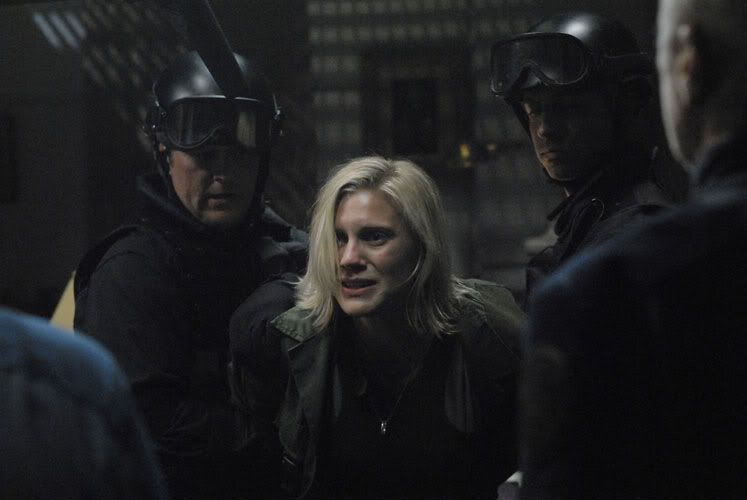 One thing that’s always bothered me about Hollywood is the way it tends to gloss over the deaths of its minor characters. It’s annoying to see James Bond mow down a group of lackeys without a twitch of remorse. But on a show like “Battlestar Galactica,” where the sanctity of human life is measured by the number 39,676, such blithe disregard for it is simply an unpardonable sin.
Tuesday, April 8, 2008
Battlestar Galactica: Season 4, Episode 1
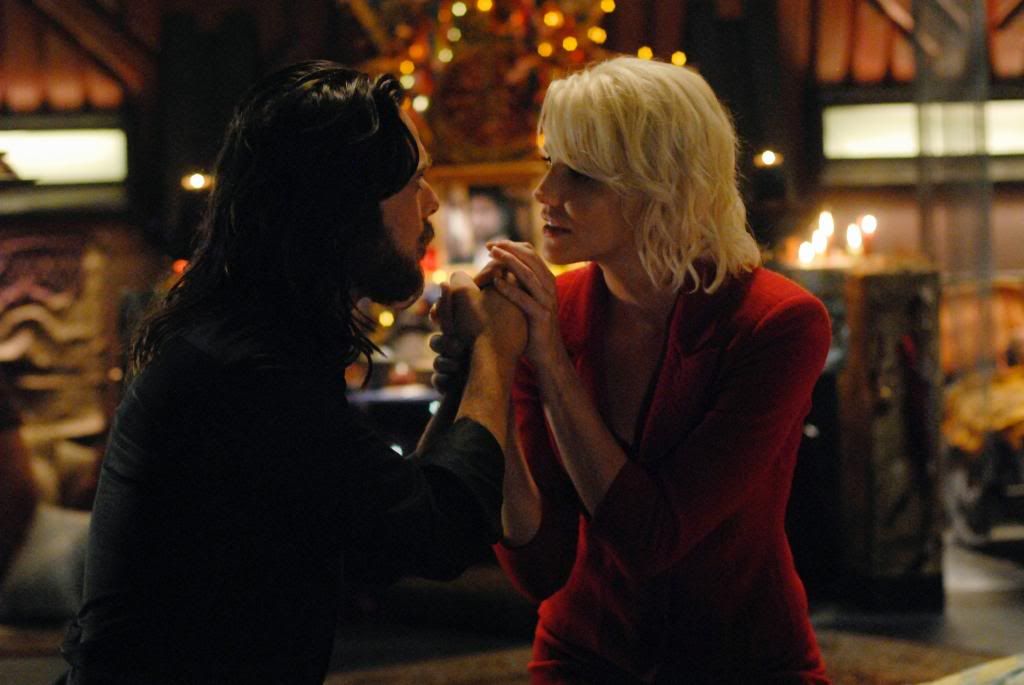
For most of its first 3 seasons, Battlestar Galactica always kept its unique mythology in the background, tending instead to focus on the more immediate concerns of the fleet. Sure, there were a few minor episodes that flashed elements of a paganish mysticism. And President Roslin’s (Mary McDonnell) character has always been at least partially defined by her certitude that she is the prophesied dying leader who will lead humankind to Earth. But many of the elements of the series’ overriding mysteries came to the fore in season’s 3 finale, which saw the outing of Colonel Tigh (Michael Hogan), Chief Tyrol (Aaron Douglass), Samuel Anders (Michael Trucco) and Tory Foster (Rekha Sharma) as 4 of the final 5 unseen cylons, to say nothing of Kara Thrace’s (Katee Sackhoff) miraculous return from the dead.
Those revelations, coming as they did in the final moments of season 3’s finale, gave the fans hundreds of questions to chew on during the year-long hiatus. That's nothing new: Galactica’s finales have always been massive cliffhangers, either by showing the ominous march of cylon centurions through the marketplace on New Caprica, or the shooting of Commander William Adama (Edward James Olmos). Still, while those previous events were mostly character-altering developments, the events of season 3 led to a fundamental shift in the series itself. Viewers were no longer asking, “What happens next?” but rather, “What the hell does this all mean?” That dynamic is something viewers of Lost will certainly understand. But if there was any trepidation that this new Galactica would falter along the lines of that show—minutiae designed for the sake of weirdness, inorganic character decisions designed to forestall eventual revelations—the events of “He That Believeth in Me” laid those fears to rest. After a breathtaking battle sequence in the opening act (the best work the Galactica effects crew has ever done), the episode settled down to do what it does best: take a look at how the events of the show effect the characters in it.
If there was a theme to the episode, it was one of identity. “Be the man you want to be until the day you die,” Tyrol admonishes Anders, echoing Tigh’s speech in the finale, post-revelation (“My name is Saul Tigh. I am an officer in the colonial fleet. Whatever else I am, whatever else it means, that’s the man I want to be. And if I die to day, that’s the man I’ll be”). While the newly revealed cylons will certainly grapple with their outing, so to speak, I’m not so sure those revelations will profoundly affect their behavior. We’ve already seen one cylon be able to overcome her programmed hatred of humanity thanks to the power of love, and certainly 3 of the final 4 have deep relationships, too. (Only Tory is something of a wildcard, but that’s primarily because we haven’t really been exposed to her in any meaningful sense.)
In any event, while the episode’s most poignant moments lay in its dramatic irony (particularly poor Anders telling Kara he would still love her even if she were a cylon, with Kara retorting that she would kill him in a New York minute if he was), the episode’s best moments were those focused on the newly-exonerated Gaius Baltar (James Callis). Baltar is unquestionably one of the richest characters on television, ever, and much of that is thanks to Callis’ wonderful ability to extract some (dark) humor from what is a mostly bleak show. That was on full display here, particularly when Baltar’s disgust with his ragtag groupies didn’t extend to his taking advantage of one of them. But Callis isn't some one-trick pony, and has anchored Baltar’s memorable arc throughout the series—from traitor to president to Marx to now, apparently, Jesus, complete with a cheesy string-lighted shrine from his groupies. Yet Baltar isn’t just Jesus, he’s also actively proselytizing for the cylon’s monotheism. Does that make him Zoroaster as well? John the Baptist? Galactica has never been one to shy away from allusions—particularly visual ones, as the shot of Baltar praying was reminiscent of thousands of Italian frescoes. It’ll be interesting to see how this plays out.
Some other thoughts:
The survivor count is getting depressingly low. They’ve lost 10,000 people (more than 20 percent ) in the span of 10 episodes.
Michael Hogan is turning in fantastic work every episode. He’s more expressive with one eye than most people are with their whole bodies.
The episode's only weak spots were Apollo-centric. For a show obsessed with its character continuity as Galactica is, it was odd to watch Apollo seem blithely unconcerned as to Starbuck's potential cylon-ness (this is the man who nearly exterminated the entire cylon race, as well as consistently belittle the Sharon-Helo relationship). In the same vein, Apollo turning in his wings to his father to get away from the military seemed an odd moment, particularly because much of season 2 was dedicated to establishing how similar the two really were.
Thursday, April 3, 2008
Choosy viewers choose skiffy
 Americans don’t do smart. Or rather, we venerate the lowest common denominator, as Paris Hilton, Real World vs. Road Rules Challenge, and the 2000 election can all attest. I used to think that this anti-intellectualist streak was a relatively new development—after all, was not our nation once a shining beacon to the rest of the world, producing such august worthies as Benjamin Franklin? Henry Adams? L. Ron Hubbard?
But lo! How quickly one forgets the pet rock, to say nothing of William Jennings Bryan and the other mountebanks in our rogues gallery. Perhaps HL Mencken—America’s sternest biographer, as well as its keenest observer of the human condition—said it best: “The great masses of men, even in this inspired republic, are precisely where the mob was at the dawn of history. They are ignorant, they are dishonest, they are cowardly, they are ignoble. They know little if anything that is worth knowing, and there is not the slightest sign of a natural desire among them to increase their knowledge.” Remember that the next time you see another Jason Friedberg movie shoot to the top of the box office, folks.
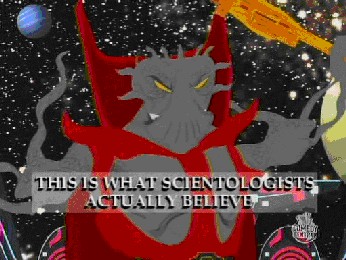
That’s probably why science fiction is so loathed here. It’s the dominion of the pocket-protected twerp with his head in the clouds, when it’s not affixed to the monitor’s eerie glow. So whenever I tell my friends that Battlestar Galactica is the best thing on television (a role it assumes by default with The Wire’s passing), I’m met with blank stares, if not outright scorn.
But screw them. There’s never been a bolder, more ambitious show. Battlestar Galactica, at its essence, is about the destruction of humanity, and how its few survivors struggle to maintain their civilization as they stagger towards a fabled lost planet called Earth. It is ferociously learned, projecting western cultural icons onto a pastiche of Greek/Mormon/Jewish/Hindu mythology, lending a disconcerting familiarity to the proceedings. Even if those proceedings entail epic space battles with a monolithic race of humanoid robots hell-bent on humanity’s extinction, which is as cool as it sounds.
Like all superlative works of fiction, Battlestar Galactica tackles tough issues without ever sounding preachy. It’s the only thing I’ve ever seen that can attempt to humanize suicide bombers—and succeed in doing so. Its universe reflects our own, in that it abandons the common tropes of television to show a world where there are no moustache-twirling villains, no white shielded paladins. Just a group of humans trying to make do.
Battlestar Galactica’s fourth and final season premieres this Friday at 10 on the SciFi channel. I’ll be recapping each episode here at NH, though I imagine many of you will be totally lost. So to help you catch up on what is a heavily serialized show, the SciFi channel has created a primer of sorts, recapitulating the meat and bones of the show’s previous 3 seasons, which you can find below. See you Friday(ish).
Click here to read more.....


