
Likewise, Deschanel gets a pass for essentially being so far out of the greater public consciousness that it doesn’t matter when she fails. And she inevitably will fail. Volume One, for all its pleasant moments isn’t exactly announcing itself as a definitive work of an assured new voice to take the medium by storm, though Deschanel’s prominent role in M. Night Shyamalan’s forthcoming The Happening promises to be a debacle enough to ensure that she’ll have the chance to produce a few more volumes of She & Him to try for something even better. And you know what? I’ll bet they’ll be pretty good, too. If only the poor movie star would be afforded the same chance. It started in late 2006, with the curio announcement that Scarlett Johansson- yes, that Scarlett Johansson- was to make an album. What’s more, she was to make an album of Tom Waits covers. Eye rolling turned into a sustained level of interest, which was piqued with the accompanying details. Dave Sitek, musical backbone of the adored TV on the Radio, had been tapped to create a backdrop for the assuredly surreal sounds to come. Cameos and collaborators piled up with each infrequent press release, along with rumors and gossip, whisperings of Ziggy Stardust sightings in the bayou, and speculation as to whether or not Johansson could actually, you know, sing. More than a year and a half later, Anywhere I Lay My Head arrived.
The average music fan has probably heard some of mostly the same criticisms. The record certainly has its rough spots, and yeah, the lows are pretty low indeed- especially the painfully-obvious music box on “I Wish I Was in New Orleans” and the hideously juvenile dance track train-wreck that is “I Don’t Want to Grow Up.” But it is also true that the highs are actually quite close to… stunning. Sitek’s now-trademark percussive drone, highlighted by string and woodwind flourishes, pair beautifully with some of the melodic highpoints of Waits’ career, which manage yoke the sometimes meandering and abstract tendencies of Sitek’s own band to some plain perfectly-written songs. While Johansson’s immature contralto stands out repeatedly in the record as a glaring point of weakness, it is, at the very least, an interesting diversion in places and occasionally manages to reach peaks simply not suggested possible by her previous known work at the mic. It turns out, that we could reverse the billing on the closing duet “Who Are You” and have a decent case that Tunde Adebimpe alone would have made this a terrific TVoTR release. Consider his tracks as nothing more than a collaboration between him and Sitek, and we could easily extrapolate Bowie's sample into an album we’d call at least 3.4 times better than Heathen and proceed to argue its relative merits alongside Scary Monsters as his last good albums. In all actuality, pretty much the entire first half of the album (up to and including the co-written Johansson/Sitek original) is an unqualified success. Johansson’s taste in covers material is vindicated by some long-overdue attention paid to a couple of Waits’ should-be classics. The Brooklyn all-star backing band cameos (members of TV on the Radio, Celebration and the Yeah Yeah Yeahs) exceed their ill-defined expectations and produce some great instrumentals. Bowie remains convincingly Bowie-like (in shades of Lou’s “Satellite of Love” no less) and Sitek absolutely produces the shit out of everything. Then we drink some lemonade, maybe watch Manhattan again, and head home happy in the early summer night.
Yet although most reviewers have claimed pretenses wanting to of give the album a fair shake, everybody seems to hedge against venturing any kind of strong sentiment as to the ultimate quality of these eleven tracks. The resulting critical response has come in deceivingly mediocre ratings and disingenuously superficial assessments. No attempt is made by anybody to reconcile the phenomenon of why this album, once a nexus of fairly intense fetishism by more than a few people, has been met with such absolute indifference upon its arrival. Given the principles involved and lopsided results, it seems that there would be at least a little spirited debate about Anywhere I Lay My Head. Yet a glance around the media reveals that it’s not just that the major outlets aren’t into it, but the fact is that nobody seems to be into it, and the question of why has consumed me... Right around the time that anticipation of the Scar-Jo record had mounted, another musical debut by an indie-crush-worthy actress arrived with little fanfare. She & Him is a collaboration between Zoey Deschanel, she of healthy filmography and radar-straddling profile, and M. Ward, he of notably consistent (and Pitchfork-approved) folk-inflected solo career. The two have produced, by all accounts a lovely little collection of songs entitled Volume One, consisting of both covers (by the likes of key Ward influences Smokey Robinson and the Beatles) and originals credited to Deschanel and produced by Ward. With a studio band assembled by Ward and featuring members of the Decemberists and Devotchka, the duo manages to recall the pop highlights of obvious idols Tammy Wynette and Patsy Cline. Despite a few missteps, like the poorly-placed slowdown of “Take it Back” and a completely useless afterthought of “Swing Low Sweet Chariot” (seriously), the album is full of affecting, hook-filled songs that know when it’s better to quit than risk going too far out of their depth.
 At a loss for explaining the different receptions for Johansson’s and Deschanel’s respective efforts, my mind wandered among a number of possibilities. Obviously, the subject of novelty in music has been on my mind recently. When and why a given project may be dismissed out of hand while another is celebrated for whatever reasons still evades me. What I have come to understand, in a very “hipster-bashing is a totally hipster thing to do” kind of way, is that coolness-as-commodity requires a level of sub-cultural protectionism. This is often taken (rightly or wrongly, but mostly rightly) as exclusionary and elitism by the world at large. And, for people who spend as much time listening to and thinking about music as I do, the single biggest conceit we seem to make for our obsession is the lonely life of being a definitive arbiter of our own tastes.
Of course, these standards become compounded by the fact of indie-rock being a still largely male-dominated society, begging the engagement of forces beyond rationale, and sometimes bordering on misogyny. Scarlett was everybody’s dream girl from Ghost World through Lost in Translation. Now we respond to the unmistakable signifiers of her being finally and totally co-opted by the mainstream: appearing in lousy Bruckheimer summer blockbusters, going bicoastal (and unabashedly “Hollywood”) and, most painfully of all, dating Ryan Reynolds. As such, these recent albums are more than anything a referendum on the state of the people who made them. Anywhere I Lay My Head isn’t especially bad, but the collective yawn it has elicited is our final proof that Scarlett Johansson just isn’t cool anymore. Divorcing our opinion of the woman’s work from any ability to care about it is the only mechanism we have to protect ourselves from the fact that such an undertaking high likelihood of being an abject failure. To invest ouselves now risks seeing Scarlett make a joke of herself- and, by extension, us- in the most demoralizing way possible: on the E! Network between comments about her upcoming role in yet another shitty (and profitable) movie. It is now abundantly clear that only thing Ms. Johansson could have done to change anybody’s opinion of her record was to be less famous when she made it. In the hands of an unknown (preferably male) quantity, we’ll not only forgive such a “novelty” project, but applaud it heartily, as in the case of the Dirty Projectors, whose Rise Above was a fixture on every cool kid’s favorites of 2007 list. A collective based in the consensus Center of the Universe (Williamsburg, apparently) has every advantage to produce- without fear of reprisal- a Black Flag covers abomination that remains, nine months after its release, as flimsy and frequently unlistenable as it did the first time I ignored it.
Wednesday, June 4, 2008
The Big Laydown

Monday, June 2, 2008
False Promises and Indiana Jones
It’s a promising proposition: rarely (if ever) is an audience given the perspective of enough time to watch a character—much less a cultural icon—evolve into something completely different, whether by conscious decision making or by fading away into obsolescence. But that potential payoff quickly disappears, as we’re quickly reminded that, while our own reality is suffused with vicissitudes both bitter and sweet, movie heroes suffer no such indignities. At a stroke, Spielberg undermines whatever deeper currents may have been at work for Crystal Skull. “We’re at an age where life stops giving us things and starts taking them away,” Indiana opines to an old friend, just after receiving news of his dismissal, but neither he nor Spielberg ever really mean it. Indiana hasn’t lost his breezy self-confidence or his superior physical skills: he’s able to crack wise and crack skulls with the same old aplomb, and all the while careening down a narrow dirt lane in a Brazilian rainforest to boot. And as for that whole life-taketh-away thing? By film’s end, Indiana ends up with a family without even trying. At the climax, Indiana once again surveys a scene of spectacular destruction, as a spaceship twirls with enough force to destroy an ancient temple and divert the mighty Amazon from its course. It’s the perfect inverse bookend to the mushroom cloud shot earlier on. Indiana is master of this domain. He has engineered these events, and he watches not from below but from above. He is no longer a solitary figure defined against the grandeur in the distance; He is the Almighty observing his creation. He is Zeus on Olympus. He alone knows what it all means, and he alone knows where it’s all going, as the promise of a fallible American hero once again circles the drain. Maybe next time. Steven Spielberg’s most blockbustery films have always wed big-budget commerciality to some stream of deeper issues running beneath the narrative’s surface—the collapse of childhood in ET, the psychology of fear in Jaws, and most importantly, the danger of cloned dinosaurs running amok on a Costa Rican island in Jurassic Park. But take away either the commerciality (as in Amistad, or A.I.) or the depth (as in 1941) and you’re left with an unsettlingly mediocre experience, and that's just what you get with Indiana Jones and the Kingdom of the Crystal Skull.
Midway through its first act, our eponymous hero, having just been launched a preposterous distance by the force of an atomic blast (in a 50s-era refrigerator—but at least it’s lead-lined, so we know this is all totally plausible), scampers up an embankment to survey the oblivion. Lurching into frame, Indiana is dwarfed completely by the iconic mushroom cloud billowing heavenwards. It’s the first of many hints that Indy has aged into a world beyond him, a world in which the miracle of the split atom is every bit as important as the miracles of the Lost Ark or the Holy Grail. In a literal flash, everything that defined Indiana Jones over the past three decades seemingly disappears: once a fierce detractor of the US government, Jones has become an OSS agent in the intervening years; a lone wolf defined by his transient relationships, Indy somehow picked up a steady sidekick in the War.
Tuesday, May 6, 2008
Iron Man: Where Have All the Cowboys Gone?

As a celluloid showcase for blowing shit up, Iron Man probably represents the pinnacle of human achievement. But as an affecting cinematic experience, it falls flat on its face, the latest turd in the bottomless toilet bowl of big-budget superhero movies. Morally bankrupt, Iron Man sates its audience’s basest retributive bloodlust without once elevating the dynamics of personal responsibility, illuminating instead nothing more than American cinema’s cultural morass.
Superficially, there’s nothing at all wrong with Iron Man. It’s visually bombastic in the best sense of the phrase, and Robert Downey Jr. plays billionaire playboy and weapons manufacturer Tony Stark with a kind of bracing aplomb. Even the plot, though sieve-like, moves briskly enough to mitigate the inevitable groan factor of its holes.
But Iron Man suffers from being a superhero film that is too afraid to pit its hero against anything more complex than some second-rate Bond lackeys. The bad guys Stark encounters in Afghanistan are just a discrete group of rogue thugs, carving up random spheres of influence and thirsting for power simply for its own sake. They’re not religious warriors, they’re not disaffected peasants mutilated by Stark’s weapons, and in a film that takes some rather awkward pains to establish its hero’s patriotic credentials, they’re never even connected to the War on Terror. Stark’s conflict with them is backed by a kind of juvenile morality that might play well on Mighty Morphin’ Power Rangers, but can’t help but be pandering in a wide-release.
Tony Stark rebels against his past by embracing it, fighting against the horrors of the weapons industry by building the most powerful one ever devised (to its credit, someone in the film points out the absurdity in this), gravely endangering the world he so recently swore to protect in the process. To the extent that we can judge any decision, it should be evaluated on its range of likely outcomes. In that light, Stark’s decisions are unpardonable sins: he brings the world to the brink and triumphs only by dint of outrageous fortune.
Stark finds it easier to use his vast resources to build a machine to satisfy his own personal vendettas (his own, and his too-heroic Afghan friend’s) instead of using them to change the global political structure he’s always profited from. In reality, he’s a charlatan, buoyed by the charm of a snake oil salesman, but we’re told he’s a laudable hero just because he has a winning smile and a cute pet robot. It’s the ultimate triumph of style over substance, and given where we are as society, that’s an all-too-common dynamic that desperately needs to end.
One other thing. Lots of praise has been spilled over the relationship between Downey Jr. and Gwyneth Paltrow, and it’s mystifying. We’re supposed to sympathize for a woman who can love a philandering (indirect) mass murderer, but can’t possibly countenance him endangering himself trying to right his wrongs (once again to its credit, Downey points out this absurdity in the film, but he never follows up on it). This is good romance? Buh? Either Paltrow’s character is pure evil, or she’s suffering from Stockholm syndrome.
Sunday, February 3, 2008
There Will Be Blood-Suckers
We here at NH are, for our intellectual similarities and mutually respected tastes, not of one mind all the time. In the interest of differing sensibilities, sometimes a text of cultural significance warrants a second take. For previous thoughts on There Will Be Blood, check out Steven's post here.

“I see the worst in people. I don't need to look past
seeing them to get all I need. I want to rule and never,
ever explain myself. I've built my hatreds up over the years, little by
little... I can't keep doing this on my own with these...
people.”

 Daniel Plainview and Tony Montana’s stories are marked by their alienation from humanity at large. Yet, both also show occasional vestigial morals in even the deepest depths of their monomania: Plainview halts Abel Sunday’s abuse of young Mary, and Montana refuses to kill the wife and children of his target for assassination. It may further be explained that such empathies as either man might still possess are hardened by betrayals from within those closest to them, Montana by Manolo’s secret union with Gina and his bitter marriage to Elvira, and Plainview by the false love of an eventually-trusted “brother” and the devastating guilt for his son’s injury. Finally, each also possesses, right through the brutal endings of each film, at least one final hope at finding actual grace in human life with members of their families. Of course, being great tragedies, they manage to fuck these up to, with Montana shattering his sister’s sanity before getting her killed and Plainview Not even allowing himself the forgiveness of his boy.
 sses, and eventually lives in extravagance beyond luxury, yet he never seems to really care about the materiality of his work. It seems clear that Anderson's comment is that Plainview's pursuiot of his calling is the only logical and productive outlet for such a clearly pronounced sociopath,even if his greatest victories (like beating Standard Oil) will always prove fleeting and never fully satiate that greater inborn hunger he feels. What's most important about that assertion might be what it suggests about the "American Dream," and of the prosperity that awaits men who brave new frontiers to draw their fortunes, be they in oil or coca, from the blood of those they meet along the way. As his hunger demands that he never stop, it is also proof that the emptiness he feels won't itself be the end of him, but rather bring the curse of eternal life. And so, where Sinclair's work wept for the forgotten stories of such barons’ nameless prey, Anderson’s epic is- in actuality- a song for our history's great and terrible vampires.
Sunday, January 13, 2008
There Will Be Boredom
 Sometimes the crush of rave reviews is so overwhelming that you just have to attend that play, or listen to that album, or buy that book, even if it you normally wouldn’t. To that end I finally succumbed to There Will Be Blood, the newest film by Paul Thomas Anderson, which is currently tracking sky-high on both Metacritic and RottenTomatoes. Anderson, who made his mark with the torpid Boogie Nights, has always received such generous praise that it brings to mind the famous maxim by that other PT, to the effect that there’s a sucker born every minute. But what’s ten bucks and a couple hours if the payoff is a great film?
That’s a question that I can’t answer. There Will Be Blood is not a great film. It’s not a good film, either. It’s a mess. Certainly it has some dazzling moments, but those moments are so few that their aggregate effect can’t possibly lift the movie above its mediocrity.
The story of There Will Be Blood, to the extent there is one, is based on Upton Sinclair’s novel Oil!, wherein a brooding, resentful oilman makes a small fortune, then makes a bigger one at the turn of the 20th Century when he starts drilling in a remote California hamlet. At the end of his life, he sits, unshaven and alone, in his stately pleasure dome, having alienated all his friends and family in the ribald quest for wealth. But all that is ancillary to the main thrust of There Will Be Blood, which, like
What you get, then, is a universe where everyone and everything exist simply to be subsumed by the oilman. Day-Lewis plays Daniel Plainview as such an inexorable storm that his apotheosis is all but inevitable. Given the movie’s source material, perhaps that’s unsurprising. Upton Sinclair has never been known for his narrative subtlety, preferring to denounce the greed of the status quo rather than offer deep introspection, and that sentiment pervades There Will Be Blood. As Day-Lewis grows richer, he abandons his son, destroys the village identity, and undermines Dano’s religious conviction. For Anderson (and Sinclair), black oil always stains more than clothes.
But it’s hard to care. His son is a cipher. The village is nondescript. And while the film’s most magical moments, the scenes between Dano and Day-Lewis, crackle with an energy that leave one wondering what a great experience There Will Be Blood could have been, they are inexplicably abandoned for great lengths of time. Instead, we get to see Daniel Plainview act predictably, as the corruptive forces of money blah blah blah. We get it. Robber barons are bad. Money is pernicious. It’s been done before, and done better.
We’re coming up on 100 years of cinema, yet some still haven’t grasped that a novel and film are separate beasts. A novel will engross you for weeks and so can incorporate many themes, issues, characters; a cinematized novel at 2 hours will necessarily suffer if it is trying to replicate its source material perfectly.
Wednesday, December 5, 2007
The King of Kong and the Eternal Struggle
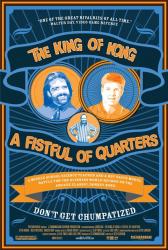 In a certain sense, it's no surprise that The King of Kong: A Fistful of Quarters, isn't getting much commercial play. It's not that The King of Kong isn't compelling; on the contrary, I'm prepared to argue that it's the most impressively told story this year, in any medium. But we Americans prefer our movies as fable, not fact. That's a shame, because The King of Kong is celluloid perfection, and a spot-on realization of the American mythos to boot.
The protagonist -- nay, the hero -- of The King of Kong is Steve Wiebe, a soft-spoken, hangdog family man who was left reeling after being fired from his job at Lockheed. To deal with this latest setback in a life even Charlie Brown would pity, Wiebe turned to Donkey Kong, universally acknowledged as the toughest classic arcade game ever created, and decided to be, just once, a winner.
What Wiebe can't possibly know is that his dreams wil put thrust him into a weird, insular world, putting him squarely at odds with the reigning King of Kong, Billy Mitchell. Per The Filthy Critic:
Mitchell wears cheap, patriotic ties that you might see on the clearance rack at Wal-Mart, has a mullet he blow-dries and fusses over, and a weasely face. He runs a chicken-wing shack, sells hot wing sauce and thinks he's pretty big shit. He looks like he's had at least one bitchin' Camaro in his past. He talks easily about how great and clever he thinks he is, even though his accomplishments don't extend beyond old video games. He doesn't do anything that won't directly reflect glory on himself. He also holds multiple records at video games, including Donkey Kong.Worse still are the assholes in the record-keeping establishment that make sure Mitchell stays the champ. These men (and I use that term loosely) are the most richly drawn supporting cast in American cinema this year. Walter Day is the captain on this ship of fools. He's the head of the video game record keeping organization (imagine a nerdier Guinness) who dresses up in a tight-fitting referee jersey to judge officially sanctioned events. Brian Kuh, meanwhile, has devoted much of his life to defeating Mitchell's record, and would rather sabotage Wiebe than see someone other than him top it.
 With the collaboration of others, they break into Wiebe's home to poke around in Wiebe's Donkey Kong, looking for a way to discredit him. They refuse to let him submit a videotaped record, even though Mitchell did. They make sure that Mitchell's record is met with fanfare (admittedly of the internet variety, but hey, publicity is publicity) and consistently try to downplay Wiebe's accomplishments.
Pitted against such an obviously corrupt establishment, Wiebe becomes the closest thing we have to a folk hero in the digital age. He is America's David, armed not with a sling but a joystick; he is Rocky Balboa in bermuda shorts. Ultimately, Wiebe's struggle is not just his own but our own, as only the earnest quest for purpose in a hostile world can be. We cringe at his failures and we exalt in his success. It's beyond Americana: it's the quintessential human tale, sung by Homeric bards and medieval troubadours, now set to the silver screen.



