
The final moments of last week’s episode saw Kara Thrace (Katee Sackhoff) in such a desperate frenzy to gain access to President Roslin (Mary McDonnell) that she lobbed a grenade at two redshirts guarding Roslin’s door. It was a shocking but effective scene, agreeing both with what we know about Thrace from seasons past (she will relentlessly do what she thinks is right, and to hell with the consequences) and what was established earlier in the episode itself—namely, that Thrace believes that she and only she can lead the fleet on the proper course to Earth. On an obsessively serialized show like “Battlestar Galactica,” that drastic action should have had far-flung repercussions, and during the show’s first few seasons it certainly would have—think back to Boomer’s (Grace Park) slowly-evolving horror at blowing up the fleet’s water tank in season 1, or Colonel Tigh (Michael Hogan) drinking himself to oblivion in the wake of New Caprica. It would have been more organic to “Battlestar Galactica” to see Thrace profoundly changed in some way. Consumed by guilt, perhaps, or becoming a fanatic willing to shed blood to spread her unique word. But neither Thrace nor her peers in the fleet seem to give the matter much thought, and by the end of “Six of One,” Thrace is back to the person she used to be, and in charge of a separate mission to find Earth to boot. Last week I observed that “He That Believeth In Me” marked a new “Battlestar Galactica,” focusing more on the series’ mythology than the workings of the fleet. “Six of One” shifts that paradigm even further, as the show seems to be concerning itself far more with plot than with character. Whether or not that’s a good thing is certainly a debatable point, since what irked most viewers of season 3 was the spinning-of-the-wheels quality to the character studies like “The Woman King” or “Dirty Hands,” episodes that many consider to be the show’s worst. But that kind of relentless plotting can sometimes lead to enormous oversights like the overlooked murder. At its best, “Battlestar Galactica” seamlessly incorporates both character and plot, but “Six of One” brings up some very valid concerns that the producers might wrap things up too quickly.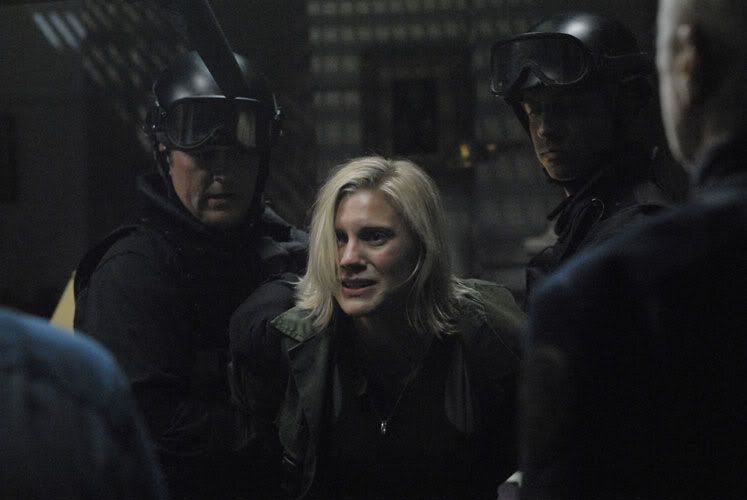
Tuesday, April 15, 2008
Battlestar Galactica: Season 4, Episode 2, "Six of One"

Tuesday, April 8, 2008
Apologies
If your RSS happened to blow up this morning, you can blame me for not knowing what the hell I was doing. Or Brendan for not telling me what I needed to know.
Actually, don't blame me at all. It's all Brendan's fault.
Battlestar Galactica: Season 4, Episode 1
For most of its first 3 seasons, Battlestar Galactica always kept its unique mythology in the background, tending instead to focus on the more immediate concerns of the fleet. Sure, there were a few minor episodes that flashed elements of a paganish mysticism. And President Roslin’s (Mary McDonnell) character has always been at least partially defined by her certitude that she is the prophesied dying leader who will lead humankind to Earth. But many of the elements of the series’ overriding mysteries came to the fore in season’s 3 finale, which saw the outing of Colonel Tigh (Michael Hogan), Chief Tyrol (Aaron Douglass), Samuel Anders (Michael Trucco) and Tory Foster (Rekha Sharma) as 4 of the final 5 unseen cylons, to say nothing of Kara Thrace’s (Katee Sackhoff) miraculous return from the dead.
Those revelations, coming as they did in the final moments of season 3’s finale, gave the fans hundreds of questions to chew on during the year-long hiatus. That's nothing new: Galactica’s finales have always been massive cliffhangers, either by showing the ominous march of cylon centurions through the marketplace on New Caprica, or the shooting of Commander William Adama (Edward James Olmos). Still, while those previous events were mostly character-altering developments, the events of season 3 led to a fundamental shift in the series itself. Viewers were no longer asking, “What happens next?” but rather, “What the hell does this all mean?” That dynamic is something viewers of Lost will certainly understand. But if there was any trepidation that this new Galactica would falter along the lines of that show—minutiae designed for the sake of weirdness, inorganic character decisions designed to forestall eventual revelations—the events of “He That Believeth in Me” laid those fears to rest. After a breathtaking battle sequence in the opening act (the best work the Galactica effects crew has ever done), the episode settled down to do what it does best: take a look at how the events of the show effect the characters in it.
If there was a theme to the episode, it was one of identity. “Be the man you want to be until the day you die,” Tyrol admonishes Anders, echoing Tigh’s speech in the finale, post-revelation (“My name is Saul Tigh. I am an officer in the colonial fleet. Whatever else I am, whatever else it means, that’s the man I want to be. And if I die to day, that’s the man I’ll be”). While the newly revealed cylons will certainly grapple with their outing, so to speak, I’m not so sure those revelations will profoundly affect their behavior. We’ve already seen one cylon be able to overcome her programmed hatred of humanity thanks to the power of love, and certainly 3 of the final 4 have deep relationships, too. (Only Tory is something of a wildcard, but that’s primarily because we haven’t really been exposed to her in any meaningful sense.)
In any event, while the episode’s most poignant moments lay in its dramatic irony (particularly poor Anders telling Kara he would still love her even if she were a cylon, with Kara retorting that she would kill him in a New York minute if he was), the episode’s best moments were those focused on the newly-exonerated Gaius Baltar (James Callis). Baltar is unquestionably one of the richest characters on television, ever, and much of that is thanks to Callis’ wonderful ability to extract some (dark) humor from what is a mostly bleak show. That was on full display here, particularly when Baltar’s disgust with his ragtag groupies didn’t extend to his taking advantage of one of them.
Some other thoughts:
The survivor count is getting depressingly low. They’ve lost 10,000 people (more than 20 percent ) in the span of 10 episodes.
Michael Hogan is turning in fantastic work every episode. He’s more expressive with one eye than most people are with their whole bodies.
The episode's only weak spots were Apollo-centric. For a show obsessed with its character continuity as Galactica is, it was odd to watch Apollo seem blithely unconcerned as to Starbuck's potential cylon-ness (this is the man who nearly exterminated the entire cylon race, as well as consistently belittle the Sharon-Helo relationship). In the same vein, Apollo turning in his wings to his father to get away from the military seemed an odd moment, particularly because much of season 2 was dedicated to establishing how similar the two really were.

Thursday, April 3, 2008
Choosy viewers choose skiffy
 Americans don’t do smart. Or rather, we venerate the lowest common denominator, as Paris Hilton, Real World vs. Road Rules Challenge, and the 2000 election can all attest. I used to think that this anti-intellectualist streak was a relatively new development—after all, was not our nation once a shining beacon to the rest of the world, producing such august worthies as Benjamin Franklin? Henry Adams? L. Ron Hubbard?
But lo! How quickly one forgets the pet rock, to say nothing of William Jennings Bryan and the other mountebanks in our rogues gallery. Perhaps HL Mencken—America’s sternest biographer, as well as its keenest observer of the human condition—said it best: “The great masses of men, even in this inspired republic, are precisely where the mob was at the dawn of history. They are ignorant, they are dishonest, they are cowardly, they are ignoble. They know little if anything that is worth knowing, and there is not the slightest sign of a natural desire among them to increase their knowledge.” Remember that the next time you see another Jason Friedberg movie shoot to the top of the box office, folks.
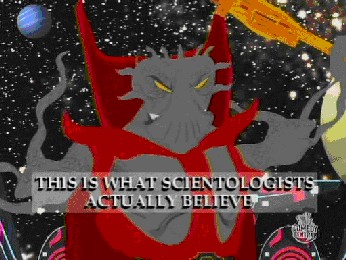
That’s probably why science fiction is so loathed here. It’s the dominion of the pocket-protected twerp with his head in the clouds, when it’s not affixed to the monitor’s eerie glow. So whenever I tell my friends that Battlestar Galactica is the best thing on television (a role it assumes by default with The Wire’s passing), I’m met with blank stares, if not outright scorn.
But screw them. There’s never been a bolder, more ambitious show. Battlestar Galactica, at its essence, is about the destruction of humanity, and how its few survivors struggle to maintain their civilization as they stagger towards a fabled lost planet called Earth. It is ferociously learned, projecting western cultural icons onto a pastiche of Greek/Mormon/Jewish/Hindu mythology, lending a disconcerting familiarity to the proceedings. Even if those proceedings entail epic space battles with a monolithic race of humanoid robots hell-bent on humanity’s extinction, which is as cool as it sounds.
Like all superlative works of fiction, Battlestar Galactica tackles tough issues without ever sounding preachy. It’s the only thing I’ve ever seen that can attempt to humanize suicide bombers—and succeed in doing so. Its universe reflects our own, in that it abandons the common tropes of television to show a world where there are no moustache-twirling villains, no white shielded paladins. Just a group of humans trying to make do.
Battlestar Galactica’s fourth and final season premieres this Friday at 10 on the SciFi channel. I’ll be recapping each episode here at NH, though I imagine many of you will be totally lost. So to help you catch up on what is a heavily serialized show, the SciFi channel has created a primer of sorts, recapitulating the meat and bones of the show’s previous 3 seasons, which you can find below. See you Friday(ish).
Click here to read more.....Monday, March 24, 2008
The Immortals: #99 - Curtis Mayfield
"Sistas! Niggers! Whities! Jews! Crackers! Don't worry... If there's Hell below, we're all gonna go!" The soundtrack for which he remains best known is, today, lessened, marred by the trappings of a movie which demanded uncharacteristically unsubtle (read: cartoonishly racist) subject matter that both dates and devalues his excellent work. I don’t care who you are, making characters like Youngblood Priest and Eddie into anything less than an offensive caricatures and cinematized stereotypes was a superhuman task. That Mayfield made from that ludicrous material music so heartfelt and enduringly resonant as to nearly legitimize pure exploitation has to be a testament to both his talent and those songs (this was proven again when Superfly became the first film to make less money than its soundtrack.) Still, while a stigma may forever be attached to that heralded “classic,” Curtis settles the debate over which was truly his best record.
Mayfield showcases every ability here. An extraordinary producer, his reverbed, psychedelic vocals and inventive instrumentation influenced everyone from Sly Stone to Jimi Hendrix. The extra material on subsequent releases of Curtis includes several future mid-hits in demo form, and comparisons display his exceptional talent as an arranger and composer in both the elegance of his studio dynamism and the visceral punch of his hard-wah riffing. And of course, as an alternately uplifting and apocalyptic lyricist, his tracks plumbed the darkest depths of politics, race, drugs and urban ill-health while never descending so deep into the engrossing paranoia as to lose faith that we could not rise above it all again.
Unfortunately, like most artists in the early 70s retroactively noted for making “socially conscious” music, that recurring message of hope is too-often remembered as the whole story of what is, in actuality, a much more significant result from Mayfield’s musical endowments. His contemporaries in the modern sounds of soul, greats like Stevie Wonder, Marvin Gaye and the Gordy-led menagerie of Motown masters, made innovative records built from the gold-selling foundations of their socially conventional pop sounds. Remember, by this time previously negative associations were merely archaic reminders of 50s race-baiting, and the 60s had officially established whites as the prime (and profitable) audience for what was now the full-cultural force of rock and roll. Even as the nation descended into ever-worsening levels of sickness in the polarized era of civil rights, Vietnam and general socio-political upheaval, the radio became as safe as milk, and new orders of catchy numbers by clean-cut representatives from any popular genre could be made to order overnight from Hitsville, Wherever. Mayfield, though of a similar mass-marketed pedigree in his back-catalogue with The Impressions, became the key figure in separating the homogenized racial legacies of co-opted rhythm and blues based musics. Unafraid to parlay in both the idioms of language and emotion found in real-life discussions of highly-charged issues, he determined that honest self expression couldn’t appeal to everyone all the time- that to create something great might well have to alienate some people in the process. Put another way, Curtis Mayfield boldly made black music that was really black again. And with that, good shit returned again to the AM dial.
One can quite likely trace a straight line from Mayfield’s first spoken words on the first cut off the first side of his solo debut to the sounds yet to come straight out of Compton, Detroit, and Brooklyn and everywhere else there was inequity in class, race or creed. Like the future works of those artists, Curtis provides a brutally authentic examination of not only its own time, but of some of our lasting American dualities. The message remains as simple as ever: we are a people rife with spiritual decay, yet together we're still capable of truly great things. Whether this amounts to a defense of gangsta rap or BET, or an attempt to reconcile any controversy associated with taking sides on our cultural divisions I’m really not sure. But what I am certain of now is that, in a towering and singular career, Curtis Mayfield once taught us that we simply couldn’t pretend we had achieved the harmony and prosperity that a unified people deserve. And he promises us that we have greatness still to earn.
Curtis by Curtis Mayfield
Thursday, February 28, 2008
The Immortals: #100 - Lee "Scratch" Perry
The story of Jamaican popular music is one of self-reinvention, where the mento sounds of the island’s dancehalls evolved into ska and rocksteady variants to create a rich and unique folk tradition over a relatively small window of time. And while the most popular and influential musicians of their era were certainly ready to put an ear to their contemporaries, only one figure could make the whole island stop dead in its tracks to see its own future: Lee “Scratch” Perry was the crazed visionary of their native musics, and everybody knew it. That’s why they flocked to him to produce their tracks, and to proudly display his mark prominently on their own legacies. His creations were rife with imperfections and non sequiturs, signifiers of his own idiosyncrasies which, like the famously detuned piano of Studio 1, sustained each note he recorded with the unmistakable ring of his personal madness. While Perry's known erratic and volatile history at times overshadows his specific innovations, a glace back at the decades since he first hit the charts reveals a more subtle and important place in rock and roll history.
 It is significant that the commercial viability of punk was first realized in England, where pop singles were propelled up the charts by seemingly nothing but the collective despair of the young, broke and angry. The Clash filled their first recordings with Junior Murvin covers, barely-veiled weed references and songs about how the only true revolutionaries in their punk explosion were found in the black clubs of Sheperd’s Bush. And you know something- they were right. When, my 15 year old self asks, did punk rockers stop listening to reggae music? After all, the towering influence of Scratch himself might be the most immediate link we have to our beloved indie ethos of Do It Yourself. Sure, the states had their share of forebears of would become punk, but any number of those proto-whatever acts were "DIY" only in the sense that they hadn’t the means to replicate the post-Motown, post-psychedelic take on American rock and soul (or the British Invaders who were themselves responding to those trends) that they aimed for. Ultimately, almost every Nugget of the garage-y goodness that we all love actually came from bands who aspired only to match the conventions of the time.
 Far more punk than those days could predict, Scratch was true to himself, an Upsetter at heart from his earliest days. He broke genre boundaries because they could no longer contain his mad genius, and he pushed standard technologies past previous limits to fulfill the drive he felt to create something that could move even his own addled soul. When the instruments couldn’t make the right noises, he re-imagined the studio itself, and when he was ready to impart his pedagogy unto others, he did so in a lab built by hand from brick and wire. And, profane in all but the eyes of Jah, he christened his studio the Black Ark. Listening to a survey of his works, from the vocal pop of the Wailers and Junior Byles to his most hard-core instrumental dubs, one senses that the man’s recordings are as close to a map of his brain as could be generated in an Earthly language. Lee Perry made music because if he tried to put his actual thoughts into words, they’d have locked him away and thrown away the key.
Arkology by Lee "Scratch" Perry
Thursday, February 14, 2008
Modern Library Top 100: #96 - Sophie's Choice by William Styron (1979)


Wednesday, February 13, 2008
The Self, The Other, The Home Team
When I was in high school, I was ecstatic to purchase the fourth album by Weezer on release day. I think I speak for every skinny nerd with glasses when I say Pinkerton and the Blue Album were my life. And I even thought the Green Album was pretty nifty. So, with a new album coming out, I was of course excited. I was a fan.
I was also an idiot. History, taste, record sales, cursory and in-depth listens, and common sense bear me out when I say that the record is awful. I’m writing this on the road, where I don’t have access to it, which is not an oversight: I haven’t intentionally listened to the album, in whole or in part, for at least three years. Their first albums were brilliant, but just because I loved what they did doesn’t mean I would love what they would do. After that experience, while I will always love Rivers and will always love that band, I will not blindly follow where they lead. I’m wearing an Against Me! sweatshirt but I’m not an apologist for “White People for Peace” or half of their last album.

In Oxford, there’s a bookshop called Blackwells. It’s described in the sort of grandiose superlatives that comes with college towns in general, and prestigious ones in particular. I’ve been traveling with only Ellis’s “Founding Brothers,” which while by no means serious history, still encouraged me to pick up a counterweight. This led me to pick up the only purchase that I’ve been even slightly embarrassed to hand to a cute, hipster book clerk - Simon Barnes’ “The Meaning of Sport.” In a cascading series of anecdotes that reads somewhere between a neonhustle post and a piece of longform journalism, he touches on all manner of topics related to sport (interesting), the process of writing about it (more interesting), and his hobbies of bird-watching and equestrianism (not interesting in the least).
Perhaps one of his more interesting digressions, though perhaps only because I was predisposed to the topic, is on the matter of fandom, or fanship as he calls it. Why is it that people tie themselves and their emotions to the successes and failures of athletes and clubs. As the match drew to a close and United could only strike once, Rohan said in passing, “I’m going to have to put three of my housemates on suicide watch.”
A psychotherapist friend of the author explains fanship as “‘A bearable way of facing the fact that God doesn’t love me.’ You desire a certain result, but inevitably, there are times when you are thwarted. The act of fanship, then is a way of seeking out and finding disappointment.” While Barnes is right to later point out that all human relationships are rooted in the prospect of such loss, we seek out both them and fanship anyway. The reward of each of these, however, is contingent on the risk that we be devastatingly disappointed when they go badly. Perhaps the friend is right to say that the choice to live and die by the standings is a way of buffering us from living and dying by our bank balances, our romances, our lives, but these don’t disappear when we constantly track the ticker to see who won or lost in the division. If we then choose to stake our mental state on the fixtures, which fixtures do we choose?
Chuck Klosterman points to the return of the Browns, and the moment when the identity of the team was so indeterminate that their fans were effectively supporting ‘(a) an incorporated municipality with a shared tax base, and (b) a color best-described as "burnt orange."’ He casts aside the former question of identity, and instead says a true fan places the sport above the team itself. Set in starker relief by international competition, where the allegiances fall within borders and allegiances that we’ve already decided “matter,” loyalty to sports clubs may be no different. Perhaps not in America, where we seem painfully frightened of recognizing any divisions in our society beyond the boroughs that divide Yankees and Mets fans and the peculiar psychological drive to support the Clippers, football teams often fall in the same city and punting says everything. Everton or Liverpool? Man City or United? Celtic or Rangers? Geography, class, religion.
Barnes answers the question of fanship differently than his friend: “Football, then, must be seen as an aspect of love.” That pledging loyalty to a club is part of an innate human drive to love, and perhaps then it matters less who we love than that we love. Then, the choice becomes more a question of with whom you love, than who it is you love. Your side may win or lose, but your father, your neighbor, your factory, your church will always be by your side through it all.

Fanship is an irrational decision. There are plenty of great reasons to follow sport: to appreciate the physical greatness, to respect its global impact, anything. But to believe with zealous fervor in the superiority and righteousness of your side? To support, as some people have said, “the court and the jerseys.” But even those change. The players, the managers, the owners, the stadiums, the kit. In America, even the cities and the names. In the most crass but realistic terms, you’re supporting a transferrable corporate entity. Any Sonics fan reading this knows what I’m talking about.
When I was a student, I hated college football. The American kind, to clarify. Not only did loath the culture that surrounded it - misogyny, binge drinking, pink polo shirts - but it inculcated a mindset that seemed closer to a right wing nationalist rally than an open-minded, liberal university that I hoped to find while doing my undergraduate degree at a notoriously hippie school. Demonizing the other and claiming superiority based on group membership isn’t what I was hoping for in a liberal arts education. And there will be people who say this builds community and spirit, and I understand that. It is with whom we loved.
But what does the same thing do for a franchise? You divide a city, you rally to the cause of raising money for a corporation, you support an ever changing reality behind a corporate facade as you watch a shitty side in the name of being a “true fan.”
Earlier, I nearly ended the paragraph that quips about Sonics fanship with the following dig: “I do.” But I didn’t. In a sense, I am a fan of the club. Since I started following the NBA, there is no team that I would rather see win a game, no team whose roster I know better, whose record I follow more closely, whose injuries I am more personally wounded by. But I am still not sure whether I am a fan of the Sonics. Since I left, they’ve set the court date to determine how and when the new owners are going to rip the Sonics out of their home and ship them off to Oklahoma City. Will I still love watching Kevin Durant as he realizes his near limitless potential? Of course. Will I forgive the franchise’s history of drafting inept big men with bad knees and hiring incompetent head coaches? Less so than I am now.

As much as I learned the lesson with Weezer, I haven’t quite gotten to the same thing with sport yet. In that I give my love a little less easily, I suppose I have, but I still have some vestiges of loyalty to the franchise regardless of their nature. I grew up loving a Mighty Ducks that won by opening a game with one of the faster teams on ice, but I still feel the same loyalty to the team of grinding bruisers and thugs that won the Cup last year. They play a game I like less, but it’s a team I like as much as ever.
FreeDarko is NBA blog that challenges the notion that sports writing can’t be esoteric, brilliant, and over-intelligent, The blog has put forward any number of remarkable ideas, not the least of which has been the device of posting tangentially referential images in longform essays which we here at neonhustle have experimented with unapologetically. The most interesting, perhaps, may be the concept of ‘liberated fandom.’ Potential, excellence, speed, swagger. An inchoate conception of sport that ignores the franchise as a timeless enterprise to be respected and looks at the player, the League, and the team as the canvas on which the former paint and the from which the latter constructs its narrative.
Since I’ve started following the NBA, I’ve loved watching Suns. I’ve loved them because the game they play is the game I like to watch. Steve Nash’s passes threading through holes that I didn’t know were there and production coming from everywhere on the court because they’re always. freaking. moving. But now, with Shawn Marion traded to the Heat for Shaq, who I doubt moves for anything but his remote control, and even then quite slowly, I’m not sure I really care anymore.
I’ll always love the Ducks, because I always will have been there with my Dad and my sister during, and we’ll always have that first finals run and that first cup. But even though I’ll always want them to win, I’ll still love a beautiful save on a breakaway even if it stops us from taking the lead. I might get some personal satisfaction out of my loyalty to Weezer, and I’m sure they’re great guys who really appreciate my support, but I think I’ll listen to someone else’s new music now. I might have gotten something out of the geographical loyalty and city camaraderie to Seattle, but I don’t know how that will last when I’ve moved out of Washington and so have they. But now if you’ll excuse me, I’m going to see how the Lakers are doing with Pau Gasol. I’m not sure if I can love Kobe, but I think I can love the game the play, and I think I can learn to love them with my sister and Brendan. Maybe I’ll call some of those old Weezer fan friends of mine and see what they think of the new Rivers material while I’m at it… Click here to read more.....
Our Ironic Pleasures

One of many problems with so-called ‘guilty pleasures’ is they not only say "I like better music than you," but say "I like the same music better than you do." In doing so they claim a "correct" experience of art, which is to say an ironic one that denigrates any sincere truth another has taken from it.
Sunday, February 3, 2008
There Will Be Blood-Suckers
We here at NH are, for our intellectual similarities and mutually respected tastes, not of one mind all the time. In the interest of differing sensibilities, sometimes a text of cultural significance warrants a second take. For previous thoughts on There Will Be Blood, check out Steven's post here.

“I see the worst in people. I don't need to look past
seeing them to get all I need. I want to rule and never,
ever explain myself. I've built my hatreds up over the years, little by
little... I can't keep doing this on my own with these...
people.”

 Daniel Plainview and Tony Montana’s stories are marked by their alienation from humanity at large. Yet, both also show occasional vestigial morals in even the deepest depths of their monomania: Plainview halts Abel Sunday’s abuse of young Mary, and Montana refuses to kill the wife and children of his target for assassination. It may further be explained that such empathies as either man might still possess are hardened by betrayals from within those closest to them, Montana by Manolo’s secret union with Gina and his bitter marriage to Elvira, and Plainview by the false love of an eventually-trusted “brother” and the devastating guilt for his son’s injury. Finally, each also possesses, right through the brutal endings of each film, at least one final hope at finding actual grace in human life with members of their families. Of course, being great tragedies, they manage to fuck these up to, with Montana shattering his sister’s sanity before getting her killed and Plainview Not even allowing himself the forgiveness of his boy.
 sses, and eventually lives in extravagance beyond luxury, yet he never seems to really care about the materiality of his work. It seems clear that Anderson's comment is that Plainview's pursuiot of his calling is the only logical and productive outlet for such a clearly pronounced sociopath,even if his greatest victories (like beating Standard Oil) will always prove fleeting and never fully satiate that greater inborn hunger he feels. What's most important about that assertion might be what it suggests about the "American Dream," and of the prosperity that awaits men who brave new frontiers to draw their fortunes, be they in oil or coca, from the blood of those they meet along the way. As his hunger demands that he never stop, it is also proof that the emptiness he feels won't itself be the end of him, but rather bring the curse of eternal life. And so, where Sinclair's work wept for the forgotten stories of such barons’ nameless prey, Anderson’s epic is- in actuality- a song for our history's great and terrible vampires.


